Observing skyrmionic cocoons in three dimensions

Recently, it became possible to image in three dimensions magnetic textures having dimension of 100 nm or even less. The joint teams of the Laboratoire Albert Fert in Palaiseau and the SEXTANTS beamline scientists, helped by colleagues from the Helmholtz-Zentrum Berlin, the University of Augsburg and the Max Planck Institute for Chemical Physics of Solids in Dresden, used a peculiar holography technique called HERALDO, allowing different projection of a sample containing “cocoons” to be acquired. Digitally combining these projections delivers a 3D map of the 3D magnetization inside the sample.

Sub-micronic three dimensional (3D) magnetic textures, notably the ones having a peculiar topology and chirality, are attracting a renew attention these last few years, partly thanks to the progresses in the imaging techniques. Among them, some are topologically non-trivial, meaning that they cannot be continuously deformed into a uniform state. Their non-trivial topology gives rise to a number of physical effects, such as the skyrmion Hall effect or the topological Hall effect. Understanding the chiral interactions allowing their stabilization and imaging their 3D internal structure has enabled the control of such effects. Among the imaging techniques stand in good position the ones based on soft X-ray imaging: the photons energy is tuned at an energy at which the absorption depends on the magnetic state of the sample, providing magnetic contrast with high spatial resolution. 

At SOLEIL, on the SEXTANTS beamline, HERALDO measurements were performed. HERALDO is a form of holography measurements which uses slits instead of holes as reference sources. The advantage of the slit is notably that it allows the sample to be tilted in the X-ray beam and hence record different projection of the sample and its magnetic state. Using a recursive algorithm, after a fairly complex treatment of images including nm-precision alignment, the 3D magnetization is reconstructed in 3D.

Read more on the SOLEIL website

Image: Reconstructed magnetization texture. The out-of-plane magnetization mz of the bottommost layer is represented in red (mz < 0) and blue (mz > 0). Zero mz isosurfaces appear as ghosty gray surfaces and a pair of cocoons (about 150 nm in diameter) are highlighted with the in-plane magnetization direction displayed as colored arrows.

New imaging technique could shed light on individual molecules


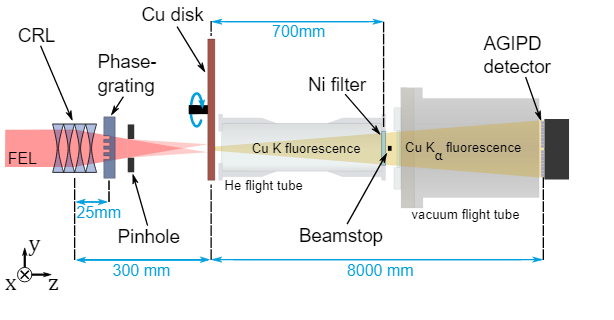
An international research team has succeeded for the first time in using X-rays for an imaging technique that exploits a particular quantum property of light. The research team, led by Henry Chapman, leading scientist at DESY and professor at Universität Hamburg, used very intense X-ray pulses from the European XFEL to generate fluorescence from copper atoms. By measuring two photons from the emitted fluorescence almost simultaneously, scientists can obtain images of the copper atoms. The research, published in Physical Review Letters, could enable imaging of individual large molecules.

The atomic structures of materials and large molecules such as proteins are usually determined using X-ray crystallography, which relies on “coherent” X-ray scattering. Undesirable incoherent processes like fluorescence emission, however, can dominate the measurements, adding a featureless fog or background to the measured data. In the 1950s, astronomers Robert Hanbury Brown and Richard Twiss coined a method called “intensity interferometry”, that can extract structural information through the ‘incoherent’ fog. The method exploits the quantum mechanical properties of light, and opened the door to new understanding of light.

Read more on the European XFEL website

Image: The sum of over 58 million correlations of X-ray fluorescence snapshots is shown in the left insert, which was analysed by methods of coherent diffractive imaging to produce a high-resolution image of the source – here two illuminated spots in a spinning copper disk. Right insert: Reconstructed fluorescence emitter distribution at the copper disc with the two beam spots clearly visible.

Credit: DESY, Fabian Trost

Synchrotron technique reveals more details of mysterious underlying portrait in Renaissance painting

Conservators and curators from the Art Gallery of New South Wales have used an advanced imaging technique at the Australian Synchrotron to gain more information about an underpainting in a famous Renaissance portrait of Cosimo I de’ Medici, Grand Duke of Tuscany from 1537 to 1569.

The painting, Cosimo I de’ Medici in armour, by Agnolo di Cosimo, known as Bronzino , is one of at least 25 known portraits of the Duke in armour and the only painting by the Italian mannerist painter in an Australian collection.

Art Gallery of NSW painting conservators Simon Ives, and Paula Dredge (now at The University of Melbourne) and curator of international art Anne Gérard-Austin, used the X-ray fluorescence (XFM) microscopy instrument to scan the portrait with the assistance of senior instrument scientist Dr Daryl Howard.

As reported in an article recently published in the prestigious art journal, The Burlington Magazine, most of the metallic elements in pigments can potentially be imaged with the technique.

Read more on the ANSTO website

Image: (left) Cosimo I de”Medici in armor by Agnolo Bronzini c1545 Art Gallery of NSW and (right) Composite XRF scan map showing mercury (red) and iron (green)