New milestone in superconducting undulator development

Successful tests confirm outstanding performance of coils

Researchers at European XFEL have reached an important milestone in developing a new generation of X-ray light sources. A set of superconducting electromagnets, produced by Bilfinger Nuclear, have proven their excellent performance, paving the way for the use of the design in future superconducting undulators. These devices will cause accelerated electrons to radiate much more effectively than current state-of-the-art technology allows. European XFEL aims to become the world’s first X-ray free-electron laser to use superconducting undulators. These undulators will unlock new research in fields such as materials science, chemistry, biology and high-energy-density science by providing X-ray pulses with significantly shorter wavelengths than have been possible at XFELs to date. 

The magnetic field of undulators is designed to be highly periodic, precisely controlled, and exceptionally uniform along the electron beam path. The electromagnets examined at European XFEL consist of niobium-titanium (NbTi) wire. At the operating temperature of -269 degrees Celsius, the material is superconducting, meaning it can carry very high electrical currents with virtually no resistance. When wound into coils with extreme precision, an electromagnet is created that produces a strong magnetic field when carrying an electric current. Measurements of their magnetic field have now been completed and show that the coils successfully reached the required operating current and produced the target magnetic field of 1.82 Tesla, while maintaining the necessary field quality for X-ray generation over the entire 2-metre length of the coils.  

This is important because using the devices to generate X-rays relies not only on the magnetic fields being very strong, but also on them being highly periodic. Even tiny deviations from this periodic structure affect the quality of the X-ray beam generated. The qualification tests demonstrate that the coils can meet these demanding requirements over their full two-metre length, making them the longest high-precision superconducting undulator coils ever produced and measured.

Read more on the European XFEL website

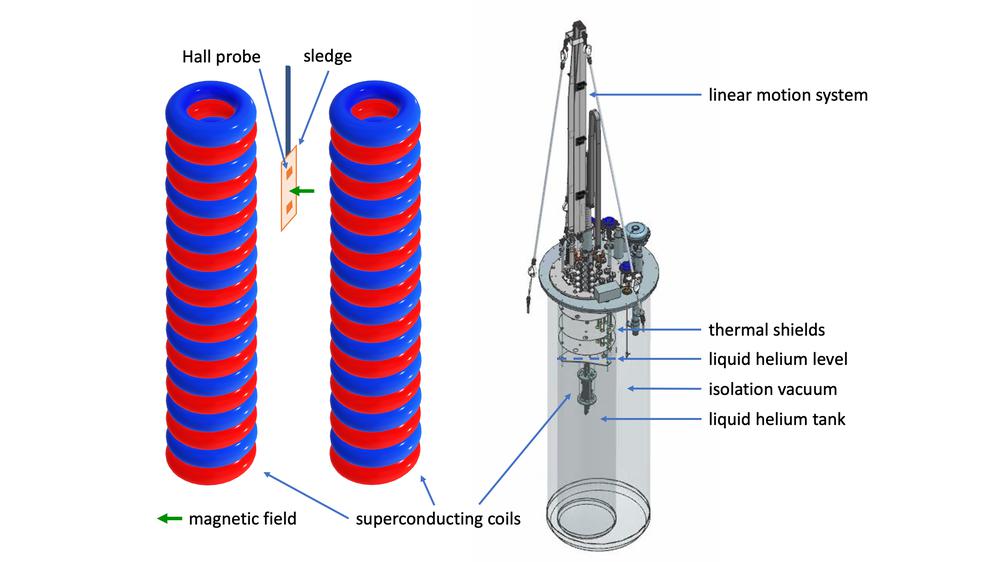
Image: The SUNDAE1 test stand and a sketch of the sledge attached to a rod with Hall probes sliding along the magnetic field axis of the SCU coils (Illustration: S. Casalbuoni et al., Front. Phys. Sec. Interdisciplinary Physics Volume 11 – 2023)

John Hill Named Director of Brookhaven National Laboratory

Brookhaven Science Associates (BSA) has named physicist John Hill as director of the U.S. Department of Energy’s (DOE) Brookhaven National Laboratory, effective May 21. Hill is a longtime employee at Brookhaven Lab. He has served as interim lab director since September 2025.

BSA’s board of directors selected Hill after a competitive international search. Hill will also serve as BSA’s president. BSA — a partnership between Stony Brook University and Battelle — manages and operates Brookhaven Lab on behalf of DOE’s Office of Science.

“We are delighted to have John Hill selected to lead Brookhaven National Laboratory at a pivotal moment for science and national impact,” said BSA Board Chair and Battelle’s Executive Vice President of National Laboratory Management & Operations Juan Alvarez. “He brings the leadership and vision needed to advance the Lab’s future — delivering transformative discovery through the Electron-Ion Collider and accelerating impact across AI and embodied intelligence, distributed quantum systems, microelectronics, and a future upgrade to the Lab’s National Synchrotron Light Source II (NSLS-II). Under John’s leadership, we are confident Brookhaven will continue to expand its science-ready infrastructure and strategic public-private partnerships in service to the nation.”

As director, Hill will work with stakeholders including DOE, policymakers, collaborating institutions, and community members as he leads Brookhaven toward strategic growth and scientific opportunity.

“I am thrilled that, following a very competitive international search, John Hill has emerged as the very best leader for Brookhaven National Laboratory at this exciting juncture,” said BSA Board Co-Chair and Stony Brook University President Andrea Goldsmith. “John’s deep expertise, vision, and leadership skills will be essential as the Lab looks to usher in a new era of fundamental physics discovery at the Electron-Ion Collider, while continuing its groundbreaking research in quantum systems, AI, microelectronics, materials science, and high-resolution imaging. Stony Brook is proud to co-manage and partner with Brookhaven to advance the frontiers of discovery to benefit our country’s innovation, economic vitality, and national security. John’s leadership will be essential to ensuring the Lab’s success and impact long into the future.”

Read more on the BNL website

Image: John Hill is pictured during his first all-hands meeting with Lab staff as interim director in 2025. His appointment as director was announced to staff today at another all-staff gathering.

Credit: Kevin Coughlin/Brookhaven National Laboratory

Towards ALBA II: A new high-stability girder system

The ALBA Synchrotron has developed a new girder system designed to meet the demanding mechanical stability requirements of ALBA II, the upcoming upgrade of the facility. These girders are key structures that support magnets, vacuum chambers, and diagnostic systems while ensuring their precise alignment along the accelerator.

In particle accelerators, girders are critical mechanical structures that must maintain the position of components with micrometre accuracy, while suppressing drifts and vibrations that could degrade beam quality. Even minimal vibrations or mechanical deviations can affect the trajectory and properties of the electron beam, having a large impact on the photon beam at the beamlines.

These girders must provide an excellent stability against external vibrations and good thermal stability, including high adjustment precision, with acceptable manufacturing costs.

While the current ALBA storage ring operates with 264 magnets distributed in 32 girders, the future machine will integrate 760 magnets in 80 girders within the same circumference, dramatically increasing the density of components, with distance between magnets as small as 10 mm. Such compactness introduces additional constraints like tighter spatial tolerances between components, and reduced margins for alignment errors.

To address these challenges, the new girder system must achieve positioning accuracies on the order of 50 micrometres between adjacent magnets, while maintaining long-term stability despite environmental and structural changes, such as slab deformation or temperature changes.

Read more on the ALBA website

Image: Girder Prototypes installed at the ALBA experimental hall with dummy magnets ready for testing

Credit: ALBA

A duo for BESSY III light source

Since 1 March 2026, Renske van der Veen and Andreas Jankowiak have formed the leadership team of BESSY III. Together, they will drive forward HZB’s central project: the planning and realisation of BESSY III light source in Berlin-Adlershof. Here, they talk about their motivation, the next steps, and why BESSY III is a a cross-generational project.

Dear Renske, dear Andreas, a new chapter for our huge BESSY III project is now beginning with you. What do you bring to the table?

Renske van der Veen: Energy and enthusiasm for the project and also for teamwork! I love working with lots of people to achieve something big. For me, BESSY III is a fantastic opportunity to put all this into practice, and I also bring the necessary pragmatism to the table.

Andreas Jankowiak: I bring 15 years of experience at HZB in various management positions and experience from different committees. For example, I have been chairing the machine advisory committee of Diamond II (successor to Diamond, UK) for six years. This gives me a sense of what is happening around us in this field and how things are developing there. I am also enthusiastic that we are a research centre with our own strong research profile, which benefits greatly from our large-scale facility BESSY. For me, this connection is an absolute added value.

Read more on the HZB website

Image: Renske van der Veen und Andreas Jankowiak take over the scientific and technical projectlead of BESSY III light source

Credit: © HZB / Florentine Krawatzek

President of the Federal Republic of Germany visits SESAME laboratory

During a state visit to Jordan today, His Excellency Frank-Walter Steinmeier, President of the Federal Republic of Germany, took time out to visit the SESAME laboratory north-west of the capital Amman. In November last year, Germany announced its intention to become an Associate Member of SESAME, cementing the country’s already long-standing support for the Laboratory. At the end of his visit, the President signed the Laboratory’s guest book, in the company of SESAME Director Dr Khaled Toukan and young researchers from across the region: “I am fascinated by the succeeding cooperation of so many countries in the Middle East and worldwide. This important work of researchers shows what a treasure international cooperation to the benefit of all of us is. Germany continues to support this place of science in the years to come.”

Germany’s relationship with SESAME goes back to the origins of the laboratory. It was the donation of the BESSY I synchrotron that allowed the fledgling SESAME to establish itself as an intergovernmental organisation in 2004. BESSY I components today form the injector for the SESAME main ring accelerator. Germany has been an Observer to the SESAME Council since its establishment in 2004.

Read more on the SESAME website

Image: H.E. Frank-Walter Steinmeier and H.E. Khaled Toukan with the scientists at the ID11L-HESEB and ID11R-TXPES beamlines.

Credit: © SESAME 2026

European XFEL celebrates a successful restart

European XFEL today celebrated the restart of the world’s largest X-ray laser with a ceremony attended by Hamburg’s Senator for Science Maryam Blumenthal and Guido Wendt, State Secretary in Schleswig-Holstein’s Ministry of Education, Science, Research and Culture. This was preceded by a so-called Long Installation and Maintenance Period (LIMP) with maintenance work and numerous upgrades to the infrastructure in underground tunnels and the scientific instruments on the European XFEL campus.

Employees of European XFEL and DESY, who were significantly involved in the extensive work, watched as Blumenthal and Wendt started the electron accelerator with a click of a mouse. Electron packets now speed again through the accelerator section to the so-called dump after about two-thirds of the 3.4-kilometre-long facility. The remaining parts of the X-ray laser, where the X-ray light is generated using the accelerated electrons, and the experiment stations will go into operation in the coming days and weeks. After more than seven months, the facility will be available to researchers again from mid-April.

Innovations for scientific excellence

At the ceremony in the Lighthouse visitor centre, European XFEL Managing Director Prof. Thomas Feurer emphasized the importance of the modification and upgrade work for the long-term performance, reliability and scientific excellence of the large-scale research facility. In addition to the successful maintenance work, for which the accelerator, which normally operates at minus 271 degrees Celsius, was warmed to room temperature and then cooled down again, teams from European XFEL and the DESY research centre installed numerous technical innovations to further expand the research options at the X-ray laser. Important upgrades include the new GUN5 electron source, which enables a pulse rate that is around 30 percent higher, and the expansion of beamlines and instruments for attosecond experiments, which can be used to observe ultrafast processes such as the formation of chemical bonds. In addition, preparatory work has been completed for the installation of superconducting undulators, which will deliver particularly short and highly intense X-ray pulses with very short wavelengths, enabling researchers to achieve even better resolution, among other things.

Read more on the European XFEL website

Image: Thomas Feurer emphasized the smooth cooperation between European XFEL and DESY, involving many teams from different disciplines.

Credit: European XFEL

Community does us proud on #LightSourceSelfiesDay2024

Inspired by our #LightSourceSelfies video campaign (featured here on our website) we invited everyone with a passion for light source science to join our #LightSourceSelfiesDay on Monday 20th May 2024.  This special day succeeded in lighting up social media with images that showed the wide range of places, people, technology, and world-changing science that makes up our amazing community.

Huge thanks to all those who participated. We look forward to repeating this activity in 2025. In the meantime, keep sharing your selfies and tagging us at #Happy20Lightsources and #LightSourceSelfiesDay2024.

Ready to join our celebrations? Mark your calendar for the 20th May – #LightSourceSelfiesDay2024

Excitement is building at Lightsources.org HQ as we prepare to see your #LightSourceSelfiesDay posts on, or around, the 20th May 2024. Whatever your connection to light sources, we invite you to join us in celebrating all that has been achieved in the past 20 years and the exciting, world changing, science that is on the horizon in the future. Let’s light up social media with images from around our international community! #LightSourceSelfiesDay2024 #Happy20Lightsources